Wednesday, August 26, 2009

The Toughest Job You'll Ever Love

Before I left for Mali, I heard Peace Corps described as “the toughest job you’ll ever love”. Boy is that true. From language barriers to cultural differences to being a replacement volunteer to staring starvation in the face to feeling completely inept and useless to loneliness and homesickness to anemia, giardia and heat rash, the last two years have been far from easy. But, I gradually came to love Kourouma and saying goodbye this past Friday was also far from easy.

The last few weeks at site just flew by. I had so much to do – baby weighings, giving away lots of random things, saying goodbye, etc. Unfortunately rain kind of affected my leaving and saying goodbye to everyone. We had a party planned for last Tuesday night. There was going to be food in the late afternoon, and representatives from all ten villages in the commune were going to gather at the Mayor’s office to eat together and give the Mayor a chance to explain that my two years were up. Well, this is rainy season. At about 4 pm I went to my homologue’s concession to see how the food preparation was going. They already had a huge pot of sauce and a smaller pot of vegetables cooking outside over a fire. I was only there for about a minute though when it just started pouring. I honestly have not seen a rain as big as the one that came that Tuesday. My homologue and some of her friends who had come over to help cook put the rice in the sauce, even though it was raining. By the time the food was ready and the rains had slowed down, half of the village was flooded. So there was no way that the meeting at the Mayor’s and the dance party could happen. No one from any outside village would have been able to travel. We still divided up the food among the Mayor’s concession, Doctor’s office and Village Chief’s concession and moved the dance party to Wednesday night. Well, what do ya know, Wednesday night it poured again! I was beginning to think that Allah just didn’t want me to have a going away party. On Thursday I was pretty stressed because it was my last full day in Kourouma. That morning I hung out with Ninon and Zeini, the two Foh teachers who helped me paint the World Map. They had come to Kourouma to drink tea and chat for a few hours before I had to leave. They also gave me a chicken as a parting gift. That afternoon I spent several hours at Maminatta’s house to see her family and this friend of the family’s who had come from another village just to see me off. I was so nervous that it was going to rain again, but the sky stayed clear and that night we were able to have the party. The instrument played was called the “dununba” which is basically just a giant drum. There was one guy who held that drum, along with several other guys who played smaller percussion instruments. There were also two women who sang. It was a typical Malian dance, with a number of people forming a circle in the center. I danced for one song which lasted about 10 minutes. It was fun because by the time the song was over, there were probably about 70 people in the circle. Unfortunately we weren’t able to have a meeting at the Mayor’s office, as the food had already been cooked on Tuesday and people were a bit unsure of the schedule of events. As a result of that, there were quite a few people, especially from out of town, but some older folks in Kourouma as well, whom I didn’t get to say goodbye to. About half-way through the dance though, Solika and I went to the center of the circle and gave a speech about my leaving, and I was able to give lots of blessings and say thanks to Kourouma as a whole as well as some individuals. By midnight I was exhausted and went on home, in order to wake up before 6 am and finish packing. Friday morning, I had been up for about 5 minutes when some people started stopping by to greet. First to come by were Maminatta’s husband, Madou, and his friend Amadou, on their way to the fields. When they started giving blessings, I just couldn’t help but start crying. Malians are really uncomfortable about crying though and so these two men awkwardly stood up to leave. After they were gone, this kid Brehima, who is about twelve years old, came by. I had given him a straw hat the day before, and he was wearing it when he came to greet me on his way to the fields. He said that my leaving was really not good with him. He said that he had not been able to sleep the night before because he had been thinking about me leaving. And then he gave me a bag of peanuts. Of course that set me off again! Over the course of the morning, many other people came by to say goodbye, several others setting me off again, and all of them just telling me to not cry, which doesn’t help. Several other people came with small gifts as well, all of which were really meaningful. One lady came by with two giant bushels of onions. I ended up being honest and saying that I couldn’t take them on the plane with me; so she took them back and gave me a few coins instead! A neighbor teacher, Diamouthene, brought me mud-cloth hat which was made in his hometown. He said to give it to my mom. Another woman gave me some fabric of this year’s September 22 Malian Independence Day. And my favorite gift: Maminatta and her husband gave me a copy of Thomasi’s birth certificate to give to his namesake! I ended up riding my bike one last time to the main road, and four other people came on two motorcycles with all of my luggage. It started raining again as soon as I had left Kourouma, and by the time I got to the main road, I was soaking wet and covered in mud. It took about two hours for a bus to come by but luckily the sun came out. Solika, Maminatta and her little Thomasi had come on one moto to see me off and they waited with me until the bus came. When the bus came, we had to run to haul all of my stuff on top and I was only able to say quick goodbyes. Driving away was certainly surreal. Even now, I don’t know if it’s hit me that I won’t be going back to Kourouma (at least not for several years).

I have slowly been coming up with a list of parts of Mali that I will miss. This is in random order and I know I’m forgetting some things, but here it is nevertheless:

-The sky – extraordinary sunrises, sunsets and starry nights
-kids both screaming my name out of sheer joy and running in terror
-friendliness of the people, including five minute long greetings with folks you barely know
-Senoufo and Bambara
-mangoes!
-my favorite Malian foods: dege, basii, and rice with peanut butter sauce
-getting so much reading done (86 books and a gazillion sudoku puzzles)
-tea sessions
-sights, sounds and smells of market
-walking down a road and seeing cows, sheep, goats, donkeys, chickens and guinea fowl all together
-balafons, kora, gita and dununba instruments
-joking cousins and bean jokes
-being in an animist village with cool fetishes
-30 cent avocados
-the expressions “Ehh Allah!” and “de!”
-being around so many cute babies all the time
-seeing outrageous clothing that the owner can’t understand: I once saw a shirt that read “Girls Gone Wild Film Crew” and another shirt with a girl’s face that said Christina Aguilera underneath – except the face wasn’t Christina Aguilera’s; bright sparkly hats and other 80’s clothing worn by young adult males
-freshly boiled cows milk with a spoonful of sugar
-going to greet for a couple hours and coming home with tons of onions and more peanuts than could feed a herd of elephants
-Dege-making sessions with Maminatta
-Beautiful fabrics and clothing – colorful basin complets for women and boubous for men
-being able to wear flip-flops year round
-other PCV’s: Mexican nights; movie marathons; true appreciation of a good cold “Flag” beer; occasional splurges on $5 hamburgers topped with egg, fries, mayo and ketchup; people who are going through the exact same thing as you and with whom you can relate
-the sound of women susu’ing (pounding with mortar and pestle) at daybreak
-having 30 kids come by at once to greet (and then promptly chasing them out – my limit is about 5 at a time)
-Djenebou: a little girl obsessed with collecting trash. She would bring me buckets of water in exchange for old bottles. She would ask just about every day if I had any new bottles. For the entire first year I thought she was incredibly annoying. After a while though I came to respect her persistence!
-eating with hands out of a communal bowl (except for spaghetti which is never easy to eat, even with fork and knife)
-going to sleep by 9:30 pm
-my Malian name, Awa (which means Eve) and nickname, Gafu
-one’s trash is another’s treasure: being able to give away broken flip-flops, old cardboard boxes, Newsweek magazines, etc.
-little Oumou and “B”: the two severely malnourished girls with whom I worked with the most. By the time I left, they were no longer in the red or severely malnourished zone (although they were still scared of me). If I had even a tiny bit to do with their weight gain, that makes my entire service worthwhile.
-old men and women who give ten blessings in a row and some of whom still go out into the fields every day
-shooting stars just about every night as I fell asleep under my mosquito net tent
-kids yelling “bon-SOIR Toubabou” at 9 am
-the people of Kourouma: especially Maminatta, Kalilou and Solika

For those who continued to read my blog up ‘til now: Thank you! I really appreciated the comments and I’m glad I could share part of my experience with you. Now I’m off to Egypt for three weeks before heading home to North Carolina, just in time for beautiful fall weather!

Awa

Monday, August 3, 2009

My pet hedgehog

Well, another month past. I celebrated my 24th birthday on July 9th in Kourouma. I know many reading this will roll their eyes, but turning 24 was quite scary! For some reason it just feels much older than 23. One reason for my fears may be due to Malians constantly telling me that I'm old and should be married with kids by now! Alas. I had an easy-going birthday. I invited Solika, Kalilu, and Nyiere over for banana cake after dinner. That morning though, Solika said that we should have chicken at the party. I said that I would give him money for it if he would buy and prepare it. Surprisingly he agreed, and at 8 pm he showed up at my house with a chicken. I thought there was no way he'd have it ready in time for us to eat that night, but he slit the throat, heated water to pluck it, plucked it in literally 3 minutes, pulled out a super sharp knife and had it perfectly chopped up in about 2 minutes and had it cooking with onions and garlic in another five. It was delicious! Kalilu, Nyiere and Bakary, a boy who always walks me home after dinner at my Homologue's house, were also there and we ate and paid tribute to Michael Jackson by listening to some of his greatest hits off of my mp3 player. Just goes to show; Malian men can cook, they just don't.


I had a pet for four days this past month - a hedgehog! After vaccinations in this other village, Solika and I went to greet his girlfriend's family. The father pointed out a hedgehog skin drying on a post. Apparently, a mama hedgehog was walking through the concession one night with her baby walking behind her. Some kids killed her to eat, leaving the baby. The skin was hers, and the father went to get the baby to show me. I held it but it was curled up in a tiny ball because it was scared. The family said that I should take it home to raise, so we got a plastic baggie, poked some holes in the side, and put the hedgehog (I named him Sidiki) inside for the ride back to Kourouma. When we got to my village, I put Sidiki in a big wash basin with some millet and crushed peanuts. He got used to me and would crawl around on my arm, but I became bored with him pretty quickly. Unless you're a masochist, hedgehogs aren't exactly good pets for cuddling. After a few days, I gave him to this little boy, Jean, who really wanted to raise him. The next morning, Jean came to my house and said that Sidiki had escaped from the box that they had put him in. I thought it was probably better, since Sidiki wasn't very happy living in captivity. About a week ago though, Jean came to my house again and said that he saw Sidiki again - he hadn't even left the concession. I asked if he had taken him and let him loose in the fields, and Jean said no. I'll let you guess what Jean did with Sidiki instead.


The last week in July was spent working on a World Map in Foh, a village on the main road about 18 km from Kourouma. As Foh is part of the Kourouma commune, the school director, Zeini Traore, saw the World Map that I did last year and had been asking me for about a year if I could come do one in his village. I went for 9 days total and got some good biking in going to and from Kourouma. It's a good thing that I got so much biking in because Zeini and this other teacher who helped out a ton with the map, Ninon Traore, fed me well! Rice with good sauce and meat pretty much every day; peanuts and hard-boiled guinea fowl eggs for snacks; cold soft drinks and hibiscus juice; enough cups of Malian tea to put me in sugar shock. After learning that I drink beer, they even bought me a beer two different days! One day, we had a pre-lunch snack of goat meat. I was full and offered the last piece to Zeini. Ninon, a big, jovial guy said "No! You need to eat it so that when you go back to Ameriki, people will say, 'Eh, Awa, you got fat!'".


Rainy season is in full-swing. While I'm glad that it's not as hot, there are several downsides to rainy season. One: mangoes are finished, and I can't express how sad I am. Two: clothes take forever to dry. I washed a bunch of t-shirts the other day and hung them out to dry. About an hour later, a pre-rain wind storm came and blew them off the line into the dirt. After cleaning them yet again, I put them inside to dry which took two days due to the humidity. Three: pretty much everyone is out in the fields all day every day, so it's really hard to greet. On Friday morning, I didn't have anything to do and decided to walk around town. I went to a couple of concessions and was able to say hello to a bunch of women who were on their way out to the fields. I finally decided to go to a concession where this old man lives, because he is blind and thus surely would be home. I got to his house and what do you know, he was out in the fields! Apparently he just knows the earth so well that even though he can't see, he can feel what needs to be weeded and what needs to stay. Amazing!

Sunday, June 14, 2009

Abdoulaye Obama

I've had a lot of small, random experiences throughout the last month, some of which I'll describe now. First of all, the soak pit project is complete! We had enough money left to build a well soak pit, which is much more work than nyegen soak pits because the amount of water is so much greater. The pipe needs to be much longer, the pit itself needs to be about four times larger than nyegen pits, and a sediment basin needs to be dug in order to catch excess mud and keep it from filling the main pit too soon. The well soak pit was supposed to be completely constructed while I was at COS conference in Bamako, because as soon as rainy season begins, everyone will be in the fields all day every day and won't have time for other work. Unfortunately the concession where we were to build the pit took forever digging the hole and didn't finish getting rock to fill it until last Saturday, well into June. Last year, rainy season was already in full swing by the end of May, but it was late this year. We began constructing the pit last Sunday and finished Wednesday afternoon. On Thursday morning, the first big rains came and by Friday, farming had begun. We finished the soak pit just in the nick of time!

The school year is officially over. The sixth and ninth graders each have big exams at the end of the year, passing into 2nd cycle school and lycee, respectively. The sixth graders had their exam at the end of May. The week of their exam, I painted a large map of Mali on one of the school walls, across from last years World Map. Three other volunteers came to Kourouma to help, and I'm pleased with how it turned out. Turns out that on the sixth grade exam, the students were presented with a blank map of Mali and had to fill in the major regions and rivers. I saw one of the teachers afterwards and he said that apparently, a couple of students were struggling on that section of the exam - so they walked outside, looked at the freshly painted Mali map, and returned to the test! I couldn't believe it. So glad that my work here is helping some Malian students cheat!

Speaking of the school, my teacher friend, Amadou Cisse, is now a father. His fiance just gave birth to a baby boy in Sikasso. Now, Amadou is the guy who is completely obsessed with President Obama. What is his son's full name? Abdoulaye Obama Cisse! When he first told me, I assumed that the Obama was an unofficial nick-name. But later Amadou came over to show me the official birth certificate. And sure enough, Abdoulaye Obama! I had heard that President Obama has lots of namesakes being born throughout Africa, but I hadn't seen it first-hand yet.

A few weeks ago, I returned home after dinner at my Homologue's house to find a black, lobster-sized scorpion in front of my front door. At first I thought it was just a plastic toy, set out as a cruel joke. Then I remembered that there is no Toys-R-Us in Kourouma where kids can stock up on the latest gag gifts. I hesitated for a moment, contemplating a course of action. I didn't want to try and kill it with my flimsy flip-flops, but the scorpion was blocking the entrance to my house where I could have gotten a sturdier smashing device. Finally I just decided to get my neighbors, who came over and beat it to death with a stick. They said that the big ones like that don't kill people or anything if they sting, it just hurts. Their reassurances unfortunately were not enough to keep me from fretting all night about scorpions getting under my mosquito net tent and stinging me to death!

While things have been going really well in Kourouma, there is never an absence of frustration. About a month ago, I went to visit little Oumou, the severely malnourished girl who never got breast milk because her mother is a student in Sikasso and after giving birth, left Oumou in the care of her grandmother. As I was talking with the grandmother, Fatima, she told me that Oumou's mother, Selimatou, recently had another baby! The father of this baby is different than Oumou's father, but is from Kourouma as well. Shortly before I spoke with Fatima, Selimatou had brought the new baby to Kourouma, left it with the father's family and returned to Sikasso. When I heard this, I was livid. The irresponsibility and immaturity of Selimatou (and both of the fathers) is dumb-founding. Now she will have not just one, but two daughters who could have but will not have received breast milk. I went to visit the new baby a few days after the conversation with Fatima, and while she's doing okay, the father is spending a lot of money on expensive milk powder. The father's mother, who is the primary caretaker, is very stressed out, having a newborn to care for all of a sudden. Oumou is now walking and has gotten a few teeth, but she isn't talking yet, is over two years old and pretty much refuses to be held by anyone but Fatima (she is absolutely terrified of me).

A few weeks ago, I was walking home in the late afternoon and passed Nyiere, a guy who works at the CSCOM. He asked if I was going to get water. I said yes and then asked if he wanted to help. He jokingly said, "oh yeah, bring two buckets and I'll carry one". So I did. When he saw me approaching with the extra bucket, he burst out laughing, but when I thrust it into his hands and made him walk to the pump, he became visibly more and more embarrassed. He did end up carrying the water all the way to my house (amid laughter by some kids playing soccer) and then quickly put it down and literally ran away so I wouldn't make him get more. Since then, when I've asked if he wants to help get water, he replies with a quick and firm "no". It was really funny, but also kind of sad. Men simply refuse to do simple chores here, because it's the woman's job, case closed. People still comment on my dad going to get water when he was in Kourouma, and that was almost a year ago!
Well, I guess that's about it. Good luck to Emma and Alex who are being sworn-in as Ukrainian Peace Corps volunteers on Thursday!
Awa

Saturday, May 16, 2009

Soak pits galore!

April was spent planning for and beginning construction of over 100 soak pits throughout the 10 villages of the Kourouma commune. A soak pit is basically a big hole in the ground, filled with sand, gravel and rock, with a pipe entering it from the water source. In our pits, the pipe led out from nyegens. The idea of soak pits is to reduce the amount of standing water, and thus decrease the number of mosquito breeding places which will decrease the risk of malaria. Soak pits also eliminate the smell that comes from the pools of standing water. For anyone who donated money to help buy the materials, thank you! Another idea for this project was simply to introduce the idea of soak pits as an easy way to eliminate standing water. In my village, I had to buy more piping because so many people wanted a soak pit after we built the first ten! I got to make several trips to Sikasso and my market town to buy supplies. One day, I had a rice sack with 170 meters of black plastic inside strapped on to my bike. Another day I rode with 12, one-meter long PVC pipes. Despite the cumbersome loads, having all that stuff on my bike made me feel like a true Malian. I'm ready now for a basket full of goats or sheep to strap on!

The Ciwaara, or dancing bush, fetish came out a couple of weeks ago, which I always love watching. One of my friends came from Sikasso to see the fetish, and I think that having two toubabs caused quite a stir. The tallest fetish chased after us a number of times, and even though I know it won't hurt me, being chased by a 7-foot tall bush-like creature is slightly frightening nonetheless!

On the night of April 27th, I had a birthday party for my mom with several teacher and CSCOM friends. Back in January, I happened to mention to this silly guy who works at the CSCOM, named Nyiere, that my mother's birthday was the 28th. He got really excited and said that when the time rolled around, we'd have a party for her. I thought that he would forget, but about a month beforehand he brought it up again, and continued to talk about it every day after that. Of course he wanted food, and not just any food, but meat, and of course since he is a male, he can't help cook it; so at about 7 pm, his girlfriend and one of her friends came over and we made spaghetti in meat and tomato sauce. The meat took forever to cook, and we didn't finish completely until 10pm. We took the food over to some other teachers' house and ate and listened to music (Akon and Michael Jackson). I was a bit annoyed with the whole food situation, but it turned out to be fun. Nyiere and this teacher who we call Cisse sang a very interesting version of Happy Birthday, which I was able to capture on my camera. We also took about 30 other random pictures, on of which is below.

I had a conversation about arranged marriages with Maminatta the other day. She herself did not want to marry her husband. She wanted to marry a Bamako guy, but once her family decided that she would marry her current husband, there was nothing she could do about it. Her old sister, Awa, has a 13 year old daughter. Awa's family had planned to marry her off to a concession across town, but the head of that concession, who is probably around 70 years old, does not want her to marry one of his sons. He himself wants to marry her! Of course I was very disturbed by that, and asked if Awa, the mother, agrees with that. Maminatta said that whether Awa agrees or not won't make a difference, because Awa's husband has agreed to the arrangement. He is the head of the family; therefore it is his decision.

We were busy with baby weighings toward the end of April. In one village, Zagneguebougou, I weighed a 2 year old girl who was only 5 kilos, or about 10 pounds. I told the mom that she needed to take her to the CSCOM, but I figured she wouldn't. Lo and behold though, a few days later, the woman and daughter, along with the father, stopped by my house on their way to the CSCOM. They were able to get some extra advice from the doctor, along with some multivitamins and other substances to help her grow a bit. I was really happy that the woman listened to me and that they took the time to come to Kourouma. I told the father several specific calorie-dense foods to give her occasionally, and he genuinely seemed like he was going to heed my advice.

That's what I've been up to in Kourouma (that and devouring the entire Twilight series - yeah, I know I'm not 12 years old. The books are addicting). This past week was our COS (Close of Service) conference in Bamako. It was good to see the folks who I came to Mali with (52 out of about 81 are still here), although I also had to go ahead and say goodbye to some folks as well. My COS date is August 27th. It's hard to believe that I only have three months left in Mali. Time flies!

Friday, March 27, 2009

It was the best of times; it was the worst of times…

I have yet to get past page one of Charles Dickens’ A Tale of Two Cities, which has been gathering dust on my bookshelf for the past six months. The first sentence rings true though in Kourouma right now. It is the best of times because…mangoes are here! My impatient waiting for the last few months has finally come to an end. Unfortunately however; with mangoes come the worst of times: hot season. I am not exaggerating in the slightest when I say that there are beads of sweat covering my face from 8 am to 8 pm and it is steadily in the 90’s.

I am in Sikasso after spending over four weeks at site. The reason I stayed in Kourouma for so long was so that I could do a HEARTH, a twelve-day program with women who have malnourished babies. There were twelve women and babies in this HEARTH. We came together every day to prepare an ameliorated porridge together, to then divide and feed to the kids, and discuss different health topics, such as the food groups, weaning, diarrhea, malaria, and family planning. The women themselves provided corn, peanut, soybean, millet and rice powder, and we also added Moringa tree powder every day, along with bananas, mango or papaya almost every day. The idea for ameliorated porridge is to include all three food groups (here we emphasize only three: protection foods such as fruits and veggies, construction foods such as protein and dairy, and energy foods, mostly carbs) and use local ingredients so that the women will hopefully continue to make ameliorated porridge even after HEARTH is over. I weighed the babies on the first and last days, and while there were a few who didn’t gain weight, no one lost weight. Despite attendance issues (on average about eight women showed up each day) and time (we were to meet at 2 o’clock each day but usually didn’t start until 4) I am overall very pleased with how HEARTH turned out. Hopefully the women now understand the importance of ameliorated porridge in getting a variety of nutrients into their babies, and now are more educated on different health topics. For me personally, it was great to get to know a group of women whom previously I recognized through baby weighings but wasn’t on a first-name basis with.

One piece of exciting news is that Maminatta had a baby boy on March 18th. I was honestly very worried about her pregnancy because she already has a herd of kids and her youngest, Sanata is only a year and a half old and underweight (she’s not walking on her own yet). Now that she’s had the baby though, I think things will be okay. And guess who the baby is named after – my dad! After she delivered, I asked how they would name the baby (a couple of her kids were named by the Imam and other kids were named after family members). She said that her husband’s older brother who is chief of their concession would pick out the name. She said the baby might be named Lamine, after her husband’s father who just died two weeks ago. Then she said that if that didn’t happen, I could think of a Christian name for him. I said that I would have to think of some names, and she said, “Well what’s your old man’s name?” I said Thomas and she said, “Thomasi Traore – that sounds pretty good.” Almost everyone I know with a Christian name has an “i” at the end, for example Moniqui and Ivertti. So Maminatta asked her husband who asked his older brother and there is now the first Thomasi in Kourouma and probably all of Mali. I feel honored that she would think to name the baby after my family.

There have been several deaths and thus plenty of greeting to do. In early February I greeted at a Sarakati (held seven days after the person dies) for an old Muslim man who owned a butiki that is right across the street from my homologue’s house. I got there at about 8 am and sat on a mat with some other women. The men were clustered together in another part of the concession. We sat for about forty-five minutes; some women chatting, others silent. At one point a man walked around with an offering basket for people to make small gifts, and later on women walked through passing out hard candies. Communal bowls of rice and sauce were also dispersed, but I followed some people and got up to leave as rice and sauce early in the morning wasn’t very appealing to me.

I wrote earlier that Maminatta’s father-in-law, Lamine, died a few weeks ago. He was Animist, so funeral greetings were slightly different. He died on a Wednesday afternoon and beginning Thursday morning, men from the concession began playing traditional instruments such as drums and a guitar-like instrument. I went to greet at noon and there was a line of people slowly dancing in an area next to the concession, led by the musicians who were wearing mud cloth outfits. Towards the back of the line were Lamine’s daughters, their clothing covered in mud. I asked Maminatta why they were covered in mud, but she just said that it was tradition for the daughters of a deceased Animist male to cover their clothes in mud. The line of people entered the concession, where the musicians stopped to play for a group of old men. They took a brief break and then continued playing music and dancing until late afternoon.

A few weeks ago a young pregnant woman came to the CSCOM from another village. When I saw her she was clearly in severe pain with malaria. She was put in a bed and attached to an IV. That afternoon, when I walked into the CSCOM concession to get water, I was surprised to see about twenty old men sitting on mats next to the pharmacy and in another cluster, a group of old women. I asked around and learned that the pregnant woman had died and a group of men had already taken her to the edge of village to bury her. Some women placed buckets filled with water outside of the CSCOM so that the men returning from the burial could wash their hands. I sat for a few minutes, offered blessings, then got my water and went home. As soon as I got home, a wind storm blew up. I stood in my kitchen, watching the CSCOM entrance through the crack between the wall and door. Pretty soon, a group of men returned from the burial site, and I could just make out their outlines as they struggled to walk through the heavy winds. As I was watching them bend down to wash their hands, I wondered if the woman’s husband was among them; the man I had given a blessing to that very morning, that his wife and unborn child would get better. Tragic deaths like that are so common in Mali that they’re not even a huge deal. It’s amazing to think of differences like that between here and the US.

After all this writing of death, I shall finish with a more humorous story. There isn’t a lot that shocks me anymore in Mali, but a few weeks ago I saw something that I just couldn’t get over. I was hanging out with this funny old woman named Ma, who likes to annoy me by only speaking in Senoufo when she knows perfectly well that I can’t understand. At one point, this little girl named Biba, who is about five years old, walked up. She was crying softly and Ma called her over. She hugged Biba to her and Biba leaned her head against Ma’s chest. Slowly, Biba reached her hand down Ma’s shirt collar, pulled out a sagging (milk less) breast, and proceeded to suck/chew on the nipple for about five minutes. Now I’ve seen babies or toddlers suck on a grandmother’s breast before, but never a child as old as Biba. I asked Biba if she wasn’t old, and Ma just laughed, pulling out her other breast and explaining that there was indeed, no breast milk there!

I hope everyone is happy and content in the US of A. I want to send a shout out to Emma and Alex who are about to depart for Peace Corps Ukraine - please keep our mother in your prayers that she doesn't have a nervous breakdown what with all of her kids out of the country at the same time! Also, GO HEELS - sweet 16 woo!

Sunday, January 25, 2009

O-BAM-A, O-BAM-A!

It’s 10 am in Sikasso, and I’m still cold! For the past three weeks, I’ve been wearing long skirts at site, sleeping under a wool blanket and heating my bath water. Every evening at my homologue’s house, we gather around a small bonfire. I have a clock in my house that measures temperature - it usually reads in the low 70’s, which isn’t that cold, but is certainly not hot. I love it!

I’ve just spent two and a half weeks at site, after my long vacation to the States. Going back to Kourouma after such a long time wasn’t as bad as I’d anticipated. Yes, a lot of people told me I’d been gone for a long time, yes some people told me I’d gained weight, but other people told me that my skin looked really good which was a nice compliment. There was of course lots of news to catch up on, mostly deaths. One old man who had died was the chief of one of the major fetishes, the Waara fetish. Forty days after a person dies, there is an event called a Sarakabo, where community members gather in the concession of the deceased in order to greet their family. For this man’s Sarakabo, the Waara fetish was out the entire day. At around 1 am on the morning of the event, I heard gunshots, drums and singing which lasted until late morning. The fetish came out again in the afternoon and stayed out until evening. After dinner, my homologue and I walked over to watch. I’d seen the Waara fetish several times before, but it never ceases to hold my attention. There were a bunch of women and men dancing in a circle. Some of the men were wearing the traditional outfit of white shorts and no shirts. Many were holding burning branches. My homologue had her six month old baby strapped to her back, and at one point when a guy holding a bunch of burning sticks started walking toward us, she turned around and sprinted fifty yards down the road. It was one of the funniest things I’d seen in a long time.

There was another Sarakabo which took place for a young woman who had died of malaria. I didn’t know her, but am friends with her father and a couple of other people in her concession. When I went to greet her father, he and about seven other old men were sitting in a room. They offered me millet beer and were just hanging out. A couple men had spools of cotton and were sewing shirts. A couple men were trimming branches to weave into mats, and a couple men were sleeping. After I left the concession, I went over to Maminatta’s to hang out with her. I told her about cremation and she was shocked. The thought that someone would have their body burned was just inconceivable to her. In Kourouma, if someone dies, they are wrapped in white and buried immediately. There is no viewing. Visitation occurs immediately after the death and later at the Sarakabo. We also got on the subject of suicide. Maminatta was also interested to learn about this, and then told me that in Mali, if an old man or woman dies, and one of their children is extremely unhappy; they can ask the dead parent to kill them, and then they’ll die as well.

A few days after getting back to site, I went to visit another friend whose name is also Maminatta. She had a little girl, Wassa, who was about a year and a half old. Wassa was underweight and had attended a porridge-making session last Spring. When I got to Maminatta’s, I casually asked how Wassa was doing. Maminatta hesitated and said that Wassa had left. Not really thinking, I asked where she had gone. Maminatta said that she had died. Apparently she had malaria, although I’m sure the fact that she was malnourished didn’t help. Although Wassa was scared of me and wouldn’t let me hold her, I knew her well, and so her death was harder to hear about than any other child’s deaths that I’ve heard about since coming to Mali.
I spent one week at the school, wrapping up HIV/AIDS animations. I want to turn my focus now to family planning, as teen pregnancy is a major problem in the commune. One day, I had started speaking with one of the 7th grade classes but they would not settle down and listen. The 2nd cycle school director walked in holding a rubber strap. I thought he was just going to threaten the students, but he walked over to a boy and gave him a quick swat on the head. Then he turned to a girl who was talking and smacked her one, two, three times on the back with the strap. Some of the kids around her were kind of smiling and laughing, so I thought it must not hurt that bad, but when I looked at the girl, she had tears running down her face. So yes, there are a few differences in school discipline between the United States and Mali.


There are a couple of young teachers in Kourouma who are huge fans of Barack Obama. Anyone who regularly listens to the radio knows who Obama is, but these two men absolutely love him. I gave each of them an Obama sticker to put on their motorcycles, and an Obama/Biden poster to hang in their house. They were really excited about these gifts. On January 20th, as I was returning to my house from the water pump, I heard “Awa” and then “O-BAM-A, O-BAM-A” and turned to see one of the teachers, Amadou, looking over his concession wall and pumping his fist in the air. I went over and he and the other teacher, Coulibably, were listening to the inauguration ceremony on the radio. They switched it to an English station so I could listen for a few minutes. I know there are some concerns about the pressure that people in African countries may place on Obama, but the enthusiasm of these two men was fun to see nonetheless!

Monday, January 5, 2009

Here’s looking at you, kid.

I like the movie Casablanca, but after spending fifteen hours in the city I can safely say that I will never live there! It’s a fairly clean city with little trash, and it’s located right on the Atlantic coast, with a beautiful beach. The second largest mosque in the world (next to Mecca in Saudi Arabia) is there and it is stunning with doors and other decorations made from tiny, colorful mosaic tiles. There are many patisseries and shops, reminding me of Paris. The traditional Moroccan food that I tried was also very tasty. But then there was the traffic. I thought Bamako traffic was bad – not compared to Casablanca. There are a gazillion cars on the road, all rushing and never really paying attention. I have never been more scared for my life!

Overall my day in Casablanca was good. I was there on layover from New York to Bamako (I spent three weeks in North Carolina for the Christmas season). On the flight, I was sitting next to a Moroccan woman named Souad who had lived in South Carolina for ten years but was going home to spend three weeks with her family. When she heard that I had a fifteen hour layover in Casablanca, she basically took me under her wing and suggested that I go home with her. We met her parents and two siblings at the airport and the six of us squeezed into her father’s tiny car for the forty minute drive to the city. They lived in a nice apartment with a view to the ocean. Her mom made enough breakfast to feed an army, consisting of crepes and honey butter, hard-boiled eggs, homemade English muffin-type things with cheese, and lemon bunt cake. After the meal I took a three-hour long nap and awoke to a heaping plate of couscous with vegetables and a glass of buttermilk. Needless to say I had my fair share of traditional Moroccan food. That afternoon, Souad and I walked to the coast, went to see the mosque, and wandered around the shops downtown.

My fear of the traffic was justified that evening when I got in a taxi to go to the train station. It was dark at that point and drizzling. I was sitting behind the driver and there were two other passengers in the car. At one point we ended up in the middle of a busy intersection (I don’t know how). There was one car parallel to us on the right side, thus blocking the driver from being able to see cars driving toward us from the right. The taxi driver inched forward at first and then must have thought we were in the clear, and pushed harder on the gas to go forward. Unfortunately we were not in the clear and a car ran into the side of our taxi. I hit my head a little bit and the lady sitting next to me hit hers pretty hard, but luckily no one was injured. I got out to see a big dent on the right side of the car and then caught another taxi as quickly as possible and kept my eyes shut for the rest of the drive to the train station. The second taxi got there safely and I got a train to the airport. So now I can not only say that I’ve been to Casablanca, but that I was in a car accident in Casablanca!

Right before boarding the plane to Bamako, I was suddenly switched to first class which was pretty awesome. The seat was roomy and we got a three course meal, including a cheese sampler consisting of brie and two other types of cheese. I ate every bite of the cheese, anticipating the only available cheese in Mali: Laughing Cow which has a consistency similar to plastic. I’ll be honest; I wasn’t incredibly eager to get back to Mali. When the plane landed though, and I started hearing more Bambara and seeing familiar sights, I was happy. I’m not looking forward to my immediate return to site where I already know for a fact that I will be bombarded with comments on how long I was gone and how much weight I gained, but after settling in, it will be good to be at my house and see my friends. It was great to see some of you over Christmas. I truly had a wonderful time catching up with family and friends, eating lots (avoiding rice, corn, potatoes and pasta when possible), listening to and singing carols, going to the Winston-Salem Candle Tea, playing on the Wii, running outside in cold weather, and hiking in the mountains. Happy New Year!

Awa

Monday, November 24, 2008

...and may God give you lots of beans!

What’s new in Mali? Well it’s the end of November, and therefore cold season has begun. Either it’s colder than it was last year or I’ve just been in Mali too long; either way, I’ve already broken out the long-sleeved shirts for mornings and evenings, have been sleeping indoors, and heat my bath water. And, I tried to wait until after Thanksgiving, but haven’t had enough willpower and have been listening to Christmas music for two and a half weeks now.

Life is still chugging along in Kourouma, with simple pleasures such as joking cousins and bean jokes to make me smile. As I was giving blessings to one of my favorite old men in village, who happens to be a Diarra and therefore my biggest joking cousin, I prayed that he would have a peaceful afternoon and also that God would give him lots of beans!

I still hang out with my best friend at site, Maminatta, pretty much every day. Because of the slow work schedule, if Maminatta wasn’t around I think I would go crazy some days! We got together again to make Dege one day and went to watch a fetish dance another day, which is always entertaining. The men had come out the night before and I woke up at 2 am to hear their drums and singing. They held a small dance the next afternoon which women could watch. Some men came to the dance carrying these huge bags on their heads. Because they had sacrificed a chicken the night before, I thought that the bags were full of chicken bones or something but apparently they are where traditional medicines are stored.

The week after the US Presidential election (yay!) was full of vaccinations and baby weighings in Kourouma and the surrounding villages. A lot of times I wonder if the women actually listen to my advice, but the other day a woman whose baby gained half a kilo told me excitedly that after I told her to start giving her baby porridge, she did, and now her child’s heavier! This past week was slow in the mornings, but I walked around a lot greeting folks whom I haven’t seen in a while. In one huge concession, from the time I entered to the time I left, I was literally surrounded by about twenty young kids – “Toubabou Awa, Toubabou Awa!!!” I did one week of AIDS animations in the school, which went alright, although I was pretty frustrated that only one out of eighty or so 9th graders could tell me what AIDS stands for – even though we went over it at least three times last school year!

Even though I’ve been in Mali for almost a year and a half, there are still culture shock moments. One came a few weeks ago when I learned that one of the women who work at the Kourouma CSCOM is a fourth wife! I thought that she was her husband’s only wife, but apparently he has three others in a nearby village. And the other day, an unmarried teenage girl in Maminatta’s concession gave birth to a one kilo (about two pound) baby girl. Despite how tiny the baby was, the mother went home pretty much immediately after giving birth.

Thanksgiving has arrived. I hope that you all have a wonderful Holiday with lots of good food and people to share it with!

Anna / Awa

Saturday, October 4, 2008

It’s been several months since I’ve written actual Kourouma news, so here goes…Rainy season was in full swing for July and August, so most of the village (everyone except young kids and really old folks) were out in the fields all day every day farming peanuts, corn, millet, rice, peppers and soybeans – to last until next rainy season. Luckily the rains were plentiful so the harvests are large. Ramadan began the first of September and just ended on the 30th, so many people fasted from dawn to dusk. I personally like Ramadan because a millet-based porridge called Seri is prepared every day to break the fast. It’s delicious and I could drink it all day long!

The biggest event of the past few months was the 48th Malian Independence Day. The fête kicked off with a dance competition the night before. A group of teens from different villages in the commune would each dance and the judges eventually narrowed it down to the three best girls and guys for the entire commune. The dance basically consists of the individual moving his/her legs back and forth as fast as possible. It got a bit repetitive but most of them put Michael Jackson to shame. One guy did his dance with a cigarette hanging from his mouth which reminded me of Fred Astaire – and anyone who can bring Fred Astaire to mind has my vote! I ended up going home before it was all over, and it was 2:45 am! Despite the late night though, everyone was up by 7 am to see the start of a 46 km bike race. While the biking was going on, other events took place in the school courtyard, such as this one game where little kids had to try to climb or jump high enough on a soap-coated pole to reach prizes of candy or crackers dangling from a hoop at the top. The Mayor, village Chief, school teachers and all the other bigwigs of the commune were sitting in the middle of the courtyard watching everything. When the bikers returned racing to the finish line, everyone went running to the road to see who would win – 2,500 plus people running in a fairly small area equals total pandemonium! I was thankful not to get trampled and ruin my new complet of Independence Day fabric. The bikers then came to the area where the leaders were sitting and the Mayor commenced to give a looong speech about Independence Day, what all Kourouma has accomplished and different organizations (he mentioned Peace Corps which made me happy). Afterwards, prizes were given to the winners of the dance competition and bike race. There may have been no funnel cakes or fireworks, but it was a fun Independence Day nonetheless!

I have a best friend in village! Her name’s Maminatta. She said she’s my age, is married with four boys and two girls, has a co-wife and hasn’t spent a day in school. She is fun and easy to talk to and we hang out pretty much every day. We talk about day to day goings on, have boy talk, and even delve into subjects such as AIDS. One day she mentioned that if a guy has a lot of girlfriends they could get sick. I asked her which sickness and she said the one which can make people lose weight or get skin sores. I asked what the name of this illness was. She asked me if I knew, and I said yes but I wanted to hear her say it. She got kind’ve flustered but after a few seconds, whispered SIDA. She knows some basics, such as that you can’t get it just from eating with someone and it can take years to get symptoms. It was nice to have this frank, open conversation with her, because most people shy away from the subject.

There are still occasional reminders that I’m living in the 3rd poorest country in the world. In the last month, I’ve heard of two young kids in my village dying of kwashiorkor, or protein deficiency. One little girl I knew. Birth rates are extremely high and I just heard about a 9th grader in another village who died from an overdose of pills she had taken to try and give herself an abortion. There is an awful section of road leading into my village and it floods with heavy rain. One morning it had poured for several hours and I walked down to see the road. It was flooded but the water didn’t stop people from going to their fields. They picked up their bikes, rolled up their pant legs or hiked up their skirts, and waded across. One woman walked across with a bowl of food balanced on her head and a baby who couldn’t have been more than a couple of weeks old strapped to her back. Then along came a couple of young boys who led an entire herd of cattle across!

As for work, well there hasn’t been much. My big project for the quarter was to paint a mural of the three food groups on a wall at the CSCOM, and then I’ve been doing animations to explain it with the women who come to baby weighings. I’ve gone to a couple other villages to do baby weighings, but other than that there hasn’t been a lot to do. So I spend my days greeting and reading. I went to the fields one day to help pick peanuts and have done other random things such as one day helping women beat shea butter and another day helping to form balls of crushed soybeans which are later sold and used in sauce as flavoring. Maminatta and I prepared Dege one morning. Dege is a millet and milk porridge which is my favorite food in Mali, but isn’t that common in village. I passed my one-year at village point the other week, which is still hard to believe. Time really does fly by! For those of you who are still reading my blog, I hope things are going well and remember that I really appreciate comments!
Alla k'aw keneya soro (May God give you health),
Anna

Sunday, September 7, 2008

Finally, you all can read about my family’s trip here in Mali! Here are Emma’s and Mommy’s thoughts, first with Susan:


Thoughts on Mali Trip, July 2008

One thing I really learned on this trip was that I am not a 3rd world country traveler. It’s not that I mind roughing it; it’s just that what I consider roughing it is nowhere close to what traveling in Mali is like! There are none of the basic conveniences or services that we so much take for granted. For the most part we didn’t have banks, electricity, cold food/drinks, bathrooms, running water, phone reception, etc., etc. Using a teller card, Visa, Travelers Checks, just didn’t work at all. We basically had to figure out how much money we’d be spending during the entire trip of 3 weeks, go to a Teller machine in Bamako (the one & only in Mali where our teller card worked) and carry the CFA all with us, cash! I’m not used to walking around with wads of cash in my money pouch even with it hidden under my shirt.

With Anna we traveled near Timbuktu, the Dogon Region, and Djenne. We traveled by van, taxi, bus, car, ferry, camel, baché (van size public transports), dump truck, pinasse (very small long boat), taxi, and on foot. Thomas said that he thought all old vehicles in the world were sent to Mali when they were worn out. We traveled on some old buses, but they always got us where we were going. The vans or bashes were always packed with as many people as they could fit inside with luggage and maybe more people sitting up on top. They were always hot with windows open (hopefully) for air to flow, but letting in the red dust as well. The roads in Mali are pretty rough. Our road in the Ashe County boonies is 3 times nicer than the highway between Sikasso & Bamako (the two biggest cities in the country). We rented a car & driver for the 7 hour trip from Mopti to an area near Timbuktu. After the first 2 hours on a horrible paved road full of pot holes we made a turn onto an unpaved sand road for the rest of the trip. That was a true “washboard” type road, at times so bad the driver went off the side to drive through the sand. It was the about the worse drive I’ve ever been on, all I could do was pray we wouldn’t break down and that the trip would end safely. It did, but then we had to do the same trip again in 2 days when we left Timbuktu to go back to Mopti! The 3 day cruise on the Bani River was actually pretty nice, and luckily the weather was great. If it had rained we really would have been stuck “up the creek”. The sad thing about the river was that it was too polluted to even dip our hand in. The erosion is really bad so the rivers are dirt colored to begin with. Add to that a lot of people washing themselves and vehicles, animals, trash, etc. and it’s pretty bad. We did enjoy the time on the river, sights along the way, and beautiful sunsets. The boat owner cooked nice meals for us (with fresh fish), we read & played cards, and enjoyed quiet time together.
Though there were some pushy sales type people in the tourist areas, the people in Mali were really nice. We felt safe everywhere we went. The pollution on the other hand was really bad. There doesn’t seem to be any system of trash pickup or removal (other than at the hotels or Anna’s house we never saw a trash can). They use a lot of plastic bags of all sizes for food items etc. and they all end up on the ground. Animals are roaming around loose all over and their droppings are everywhere too. A lot of places had open sewers and we even saw sewage running on the road. I thought the cleanest place we saw was actually Anna’s village. (Maybe because of the medical center and presence of Peace Corp there, I’m not sure.) After 11 days on the road spending each night in a different place we finally arrived in Kourouma for a 7 day stay.

From the minute we got to Anna’s village we were welcomed by everyone with open arms. The neighbors came out to greet “Awa’s family” with smiles all around. Anna taught us to greet in Bambara, and people were so happy when we made attempts to talk in their language. Greeting is very important & formal and we spent a lot of time in Kourouma greeting people. The children were wonderful too, and there were bunches of kids everywhere. Any time the gate to Anna’s concession was open children would come in just to sit and visit, or check to see what the Toubab’s (translated French people since most white people in Mali are actually French) were up to. Since we were in Mali during rainy season most of the adults were out in the fields during the days. The babies are with their mothers (actually tied on their backs) and the school age kids are working along with the adults. That leaves the pre-school age children in the village basically on their own running around wherever they want. Coming from the safety conscience American world it was very different.

We had more than enough to eat in Mali, though it was quite a bit different from what we are used to. My favorite was the pasta with onion sauce. A lot of chickens met their fate while we were in Mali; small ones are cooked in a lot of the sauces. I didn’t care for the millet porridge, but was happy to eat up Anna’s oatmeal packets. We were lucky to be in Mali when mangos were in season and ate them for dessert about every meal. It was nice to be able to buy cold yogurt (liquid in a plastic bag) when we were in bigger towns. (I must admit I was happy to get on Air France and enjoy a wonderful meal with a glass of wine on our flight out of Bamako!)

My favorite thoughts of Mali include: friendly smiling faces; my handmade Peace Corp Mali bag; cold Mali beer (in bottles); laughs as we all got “up” on our camels for the ride into the desert; beautiful views during our hike in the Dogon; sleeping under mosquito nets “up on the roof” under the stars; our guide Oumar “it’s complicated”; the clear waterfall near Ende; the endless patience of the local people; card games on the Bani; our chicken dinner in Djenne; beautiful children wanting to hold our hands wherever we walked; Nutella; Anna’s wonderful front porch (great shade all day long); having a 3 week old baby tied on my back after her mother “went home”; seeing the children with their Carolina dollies; “Mexican dinner” with the PCV’s in Sikasso; the little bead bracelets; the wedding women on the baché in Bamako; and too many others to mention.

It was wonderful to see how Anna has adapted to her new home. We were amazed at: the way she was able to communicate in both French and Bambara; how she negotiated prices for us, even walking away when she thought the price was too high; how she pumped her water and carried it home on her head; watching her play with the children and handle the babies; and watching her greet everyone with respect. We are so proud of her and the work she is doing in Mali. I am so glad to have seen her village and been able to meet her friends. It’s so nice to know where she is, to have a picture to put with her words. I feel very comfortable about her safety and the people she’s around.

It was an interesting trip. I was so very glad we got to go, and I was so glad to come home. We love you Awa,

Aminatta


“It's complicated.”

That's what our Dogon Country guide, Oumar, said a number of times during our three days with him. Usually when he was trying to describe part of the Dogon culture that was too complicated both for us to understand and for him to translate. Once when he was trying to describe a romantic relationship. I find the phrase helpful when trying to describe our trip to Mali. Of course, it doesn't help you understand Mali, but it's the best I can do.

On one hand, Mali is beautiful. The northern part is the Sahara Desert. Looking out from the plane on our ride in, I saw waves upon waves of brown sand – not a body of water or green patch in sight. We visited the edge of the Sahara near Tombouctou: light brown sand, small trees, scrub brush. Dogon Country, further south, was unbelievable. Huge red rocks interspersed among green fields and huge baobab trees. Clear streams and waterfalls. Then, in the southern part of the country, around Anna's village of Kourouma, green. Green fields, green fruit trees, green hills. A contrast to the red dirt of the roads, the concessions, the ground peeping out in between rows of crops.

On the other hand, Mali is dirty and ugly. I saw zero trash cans. Trash littered the ground, especially in the cities, even mere feet from the amazing Djenne Mosque. Sewage ran (or pooled) in open ditches and across alleys. The Sikasso market was a mud pit even on a dry day. People live and work in this environment, and they are dirty. Children run and play in the dirty streets without shoes.

On one hand, the Mali people are not well off. This is one of the poorest nations in Africa, in the world. From a young age, children work hard: taking care of younger siblings and helping in the fields. School kids memorize their lessons in French (although they don't truly understand the language), in classrooms of 100 students, with teachers who may not care about them at all. Of those who are able to stay in school until the ninth grade, only a few will pass the test that allows them to go on to attend high school in the nearest city – if they can afford to live away from home. Women and girls marry young and are not well informed of contraception methods. In addition to raising children, they do all the work around the house and work in the fields. (The men work in the fields when the season is busy. Otherwise, they do very little manual labor.) Malians are susceptible to many dangers and diseases, from children who run around within feet of open wells to adults who must sleep without mosquito nets.

On the other hand, Malians are lucky. They live simple lives without all the extra stuff that distracts us Americans and gets in the way of our enjoyment of life. They get up, go to work, and go to bed, and that's okay. They are very close and connected to their families. “Vacation” often means visiting family in some nearby town or city. They laugh and work and laugh and greet one another and laugh and talk and laugh. They are happy. There is something very attractive about such a life.

Finally, on one hand, Mali is a very difficult place to visit, coming from our privileged American lifestyle. No running water (except in the cities), little drinkable water, no refrigeration, definitely no air conditioning, few “normal” toilets, and no toilet paper. It is hot; it is dusty. At the end of the day, all I wanted was to sit in a cool spot, drink a cold beverage, and eat a cool meal. Yes, the shade was cool, and we occasionally got a cool drink, but the food was always steaming. Huge pots of rice and couscous and macaroni, covered with sauce and meat that had been cooking for hours.

On the other hand, Mali is an easy and delightful place to visit. The people are incredibly nice and welcoming, and they will go out of their way to greet you. Anna's neighbors and people of Kourouma provided us with more food than we could eat. The children are intrigued by the white folks and either react with tears or laughter when we look at them or speak to them. The brave ones walk right to grab hold of a white hand. Despite the difficulties of travel, I look back fondly on our time in Mali and the people we met there. As happy as I was to get back to the comforts of home, I was slightly sad that I couldn't spend more time truly getting to know such an amazing people of such a different world. I am thankful for the opportunity to get a small glance into the different, difficult, happy, complicated lives of those in Mali.

Bintou (Emma)

Friday, August 15, 2008

I’ll never think of powdered milk the same again…

At the end of July, I departed for Ghana with two fellow PCV’s, Katie and Becky. We knew it would be a loooong trip overland, and it certainly turned out to be. We left Bamako on a Tuesday morning. The first leg of the trip through Mali was fine. Once we got to the border of Burkina Faso however, the troubles began! We had to get off the bus at a couple of different spots along the border. At the first stop we got our Visa’s and checked luggage was examined. At the next stop, several guards got on the bus to look through our carry-on’s. There were a couple of guys who had with them huge plastic bags filled with tons of packets of Vivalait powdered milk. The guards took the milk off the bus, and as all of us enthralled passengers watched, they announced that the content of the Vivalait packets was actually cocaine! So…for some nonsensical reason, we had to backtrack about 45 minutes to a prior checkpoint, where the cocaine dealers were taken into a room and questioned for about an hour. Then we learned that our bus would have to stay put for further examination, so we had to sit in the dark and wait two more hours for a second bus to come pick us up. We got to Bobo-Dioulasso at midnight, and found out that we’d missed our connecting bus to Ouagadougou, the capital where we would later get buses for Ghana. Luckily Becky had been smart enough to bring her big mosquito net tent, so we set it up in the station waiting room and got some sleep. The next morning we were up early to get tickets for the first bus to Ouaga – but it was full! I planted myself next to the bus door and as it turned out, about four people who had previously reserved tickets didn’t show up – so we got on!

We got to Ouaga on Wednesday afternoon and got a bachée (small bus) to take us to the North of Ghana. Well, let me just say that going to Ghana served as an indicator of the reverse culture shock I’ll probably experience when I go back to the United States. Here were some of the reactions that we had while on the road entering Ghana: “Two-story houses!”, “White lines painted on the sides of the road!”, “Lawns!”, “GUARDRAILS!!!”. We had a short return to reality when we transferred to a larger bus and were packed like sardines for the 9 hour trip to Kumasi. After a smelly, uncomfortable and sleepless night on that bus, we finally made it to Kumasi on Thursday morning. We spent Thursday wandering around Kumasi, an interesting market city with just about everything imaginable being sold on the side of the road, including washing machines and diapers. Despite how busy the city is, it was remarkably clean, with no about-to-overflow sewage and dirt. We were amazed to get back to our hotel after a full day of walking around and not have to scrub our feet for ten minutes.

It was very interesting coming to a Christian country. We saw knees and even thighs! As Ghana is an English speaking country, we were able to notice that about 80% of the shops had Christian names, such as GIGA – God is Great Academy, King David Pharmaceuticals, How Great Thou Art art store, and my personal favorite: Except God phone store (and that’s really how it was spelled). We saw signs for breast enhancement and weight loss, along with posters for the lottery.

On Friday we spent most of the day again on transport – the driver played bad country music and we saw two young Ghanaian women pull out lunch that they’d packed into Tupperware containers – complete with spoons and napkins (in Mali if you’re going to pack a lunch it’s piled into a plastic bag and eaten with the right hand). We spent Friday night in a coastal town called Axim and on Saturday finally made it to the beach! The next few days were very relaxing, with lots of sun (of course I got burnt on the first day), waves and good food.

On Tuesday we packed up yet again and left for Cape Coast. Once we got there, we spent the afternoon looking at Cape Coast Castle, which served as an old slave fort. There were dungeons where hundreds of slaves were packed together, with no bathrooms and only tiny windows for ventilation. They would go through an examination and the cream of the crop would be picked for the slave ships. Then they would be moved through an underground tunnel leading to the dock. Slaves that were hostile would be moved to a jail cell where they were kept until they starved to death. There was an interesting plaque that had been inscribed since the abolition of the slave trade, stating basically that the past was past and no hard feelings were had; along with a prayer that nothing as abominable as the slave trade would ever occur again.

Wednesday morning was spent walking through Kakum National Park. We didn’t see any animals but it was fascinating to learn about all the uses of the trees – from usage to make sponges and eye drops to serving as a cure for diarrhea and impotence!

On Thursday we left for the capital of Ghana, Accra. The next few days were spent eating, walking around, eating, shopping, and eating. There is a Champs Sports Bar in Accra – and we had real nachos! We got together for drinks with some Ghanaian PCV’s. It was interesting to hear about Peace Corps life in another country. I think they were a bit annoyed with a stereotype that Ghanaian volunteers have it “easy”. Like my friends and I, most people coming into Ghana spend all of their time in the more touristy areas which are of course going to be more developed. So even though we found luxuries in Ghana that we can't find in Mali, Ghana still has a long way to go in terms of education, health care and sanitation.

By Sunday it was time to go home. Unfortunately we still had over two days of bus travel ahead of us. We ended up breaking out the mosquito net tent again Sunday and Monday nights and finally made it to Sikasso on Tuesday. It was a nice vacation and Ghana is truly amazing, but it’s honestly good to be back in Mali!

Monday, July 28, 2008

This is just a quick blog to say that my parents, Emma and I had some wonderful adventures traveling throughout Mali. I'm going to try and have them write their own blogs to add to this site, so you can read some of their own thoughts on the trip! I'm off to Ghana tomorrow for a vacation from my vacation!

Tuesday, June 17, 2008

Live birth

A few weeks ago I got to experience the bus ride from hell. I was coming back to Sikasso after getting a Ghana Visa in Bamako. I got to the bus station at 2:30 pm and was told we’d be leaving at 3:30. So I bought my ticket and waited. By 4 we hadn’t left and when I asked I was told to sit for a little bit longer and soon we’d leave. At 5, people with large luggage were called to stand by the bus; however the luggage wasn’t loaded until after 7. We finally pulled away after 9 pm! Of course I was already livid considering I’d been flat out lied to, but the troubles had just begun. At midnight, about halfway between Bamako and Sikasso, the bus broke down. Some guy kept going and coming with the battery, apparently trying to fix it, but it never worked. By 8 am, after a restless night of attempting sleep and sitting next to a guy named Jubilee who kept humming what sounded like the dreary song the band played in Titanic while the ship was sinking, the bus still wasn’t fixed. I was able to hitch a ride with a French guy who’s lived in Mali for twenty years, and eventually got to Sikasso by 11 am.

Other than that horrible experience, things in Mali have been just fine the last month. I’ve been busy the last week and a half painting a big World Map on one of the walls at the school. Two other volunteers came to help a bit, and I let the school kids’ paint in the countries and oceans. It’s been a fun project and everyone’s been really enthusiastic about it.

I had a final AIDS presentation with the 9th graders a few weeks ago, and decided to do condom demonstrations, using a banana. It turned out great, even after the banana busted halfway through the demonstrations! The kids were really into it and two girls even voluntarily came up to do the demonstrations themselves. If I’d have had enough condoms, I think half the boys would’ve volunteered. Since then I’ve had a few kids stop by to pick up pamphlets that I have available with more info on HIV/AIDS. It was really encouraging to see some kids so excited about learning more about the disease.

This past week Solika and I have been going to other villages in the commune for vaccinations/baby weighings, and I’ve been doing porridge demonstrations in them as well. Overall, they’ve gone well although I think the mothers end up drinking more of the porridge than their babies, which kind’ve defeats the purpose. As for other health stuff, I saw my first live birth on Thursday! The baby weighings had finished for the day in Kourouma, just as a pregnant woman showed up to the maternity. The entire process, from her entering the maternity to weighing the baby after it was born, took less than 30 minutes! The mother came in and she was in a lot of pain, so my homologue gave her a shot to speed the contractions. I left and when I came back shortly afterwards, the mother had begun pushing and the baby pretty much just slid out! It was interesting comparing this Malian birth to American births. Not that I’ve ever seen a live birth in the States, but I know it’s an extremely sacred and emotional event. Here in Mali, the new father stood outside the maternity the whole time. After the birth the baby was carried into a rest/recuperation room. The father didn’t even ask to see the baby, or ask whether it was a boy or girl. Not that he doesn’t care or isn’t a good dad – it’s just different. Giving birth is a normal, everyday thing. Most new mothers themselves rest for no more than twelve hours and then they’re back at home, probably washing clothes and cooking.

My mom is really creative and has been making special UNC dolls to give to little kids in Kourouma. I gave the most recent doll to my friend Maminatta’s daughter, Sanata. Sanata is only 9 months old, but I thought she’d still be able to play with the doll, and has on older sister with whom she can share it. Anyway, when I first gave the doll to Sanata, she was confused and didn’t really know what it was. So Maminatta whipped out her breast and put the doll to it, to show Sanata that the doll is like a little baby!

Well that's it from here. The next time I post will be after the Griffis family is together in Mali. If you haven't been able to tell, I'm so excited about seeing my family I pretty much freak out every day! Send me comments, send me emails and I hope you all are well!


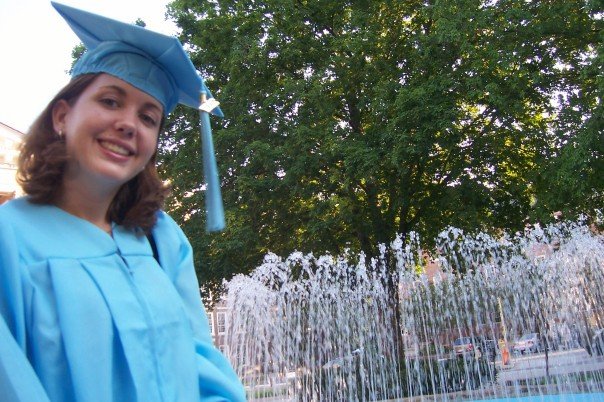
Anna

Monday, May 19, 2008

It's Rainin' Mangoes!

Hot season is here – yet with it come mangoes! They haven’t even turned ripe yet in Kourouma, but have in nearby villages so they’re easily accessible. I eat at least one or two a day (or five) so I’m definitely not worried about my levels of Vitamin A. I’ve also been hauling my mosquito net outside every night for the last month or so, which is nice because I can fall asleep looking at the stars, and get the occasional breeze.

At the beginning of April all the PCV’s from my stage and our homologues went to Tubaniso for a week of training. It was good to see everyone, and four of us went back to Banankoro one day to see our host families. I got to see all of my favorite kids, two of whom had gotten a lot bigger just in the six months I’d been away. And one of my host moms had a baby shortly after I left, so it was exciting to see her. After training, a lot of PCV’s hung around Bamako for a few days which was fun. The night I got back to site, Solika and Kalilu stopped by to greet and told me flat-out that I’d gained weight, which of course I just loved to hear.

As for work, I’ve started doing porridge demonstrations. The first one was in Kourouma, and I invited nine women with malnourished babies to come. One woman didn’t show up, and I had to get on my bike and track down three other women , but two extra ladies came so we ended up with ten. The porridge turned out delicious, and I did a food group animation with the help of a lady who helps with baby weighings, Fatoumata. She’s super smart and translated what I said into Senoufo and elaborated on it. Hopefully I can keep in touch with the babies who came to the demonstration, especially one little girl, Oumou, who’s as sweet as can be, but one of the most severely malnourished kids I’ve seen, because her mom is in school in Sikasso, leaving Oumou without sufficient breast milk. This is the cause for most of the severe cases I’ve seen: either the mother is away in another town, or died, leaving the child without breast milk. And animal milk and formula are risky substitutions because animal milk always has to be boiled and water for formula may be unclean. Anyway, I also did porridge demonstrations in two other villages in my commune, with about 30 women each. The plan is to do this in 7 other villages in the commune.

I’ve also been doing HIV/AIDS animations at the school, which have gone really well overall. The first week we focused on facts and myths about the virus, such as that it’s not found anywhere in Mali. The next week we studied what can and cannot transmit HIV, and last week learned about symptoms and prevention. Exams have been going on and school ends mid-June, so I don’t know if I’ll get to go back this year, but I’m excited about coming up with new lesson plans and activities for next school year.

Of course I can’t write a new blog entry without bringing up the fetishes! First off, right before April training, the “ciwaara” fetish came out, which was basically four men dancing in the middle of a circle wearing what looked to me like huge bushes. They let me take pics as long as I gave a little money to the old men so that they could buy kola nuts.

And then recently the “kori” fetish has been out. They came out about once a week for a month. It was a ton (probably over a hundred) boys and grown men who would walk in a pack without shirts on and chant (the chant reminded me of that of the flying monkeys in Wizard of Oz). They were always brandishing sticks, some lit with fire, and supposedly they would beat any passerby’s whom they came across. So when it was a day for them to come out, everyone would warn me not to leave my concession, or I’d be beaten!

This has been my life in Mali for the last month! I’m counting down the days for when my family comes (July 7th)!!! Miss you all and hope to hear from you.

Monday, March 24, 2008

Two Weddings, Two Fetishes and a Funeral

Since my last blog I’ve been unusually busy at site which is great! In the last month we’ve been to eight other villages to do baby weighings along with the weekly Kourouma weighings. I also did more animations at the school on diarrhea and malaria, and then we spent one week playing a review game on all the material. When I say animations, they are just small talks. So for with women at baby weighings, I just tell them how to feed their kids up to two years of age. Then I ask questions at the end to make sure they understand. Same with the kids at school. We go over the topic and then play some sort of review game at the end of each session. I try to have pictures or actual activities when possible because it’s a treat for the students. In most Malian schools, everything is rote memorization. Seventy-plus kids are jam-packed into a room with three students per desk. The teacher writes in small cursive on the board and the kids copy it down and then go home to memorize. There are no pictures or maps in the room. (World maps would be a nice thing for people to send me because I could give them to the school – although they would need to be in French for the students to understand.) I do all of my animations in Bambara even though usually at the school the kids learn in French. I was surprised to learn that kids as old as ten and eleven can’t even read Bambara because they’ve been learning in French from day one. Anyway, for the session on diarrhea we did an activity at the end where I got five volunteers to come up and put hot pepper on their hands. Next they had to wash their hands with just water, which doesn’t remove the hot pepper. Then they washed with soap and water, which did remove the smell. The idea was to show that washing with just water does not remove diarrhea-causing bacteria. Most people in my village don’t wash their hands with soap, ever. I like doing the animations but I know that people have a hard time understanding me sometimes. There have been random times when I talk to kids and they don’t understand the word “or”. I asked one of my friends for example, “Do you play football everyday or once a week?” She said, “Yes”. I repeated the question, emphasizing “or” and she again responded “yes”! This happens all the time!

Last week there was a meningitis vaccination campaign in Kourouma. It was a major event, vaccinating babies, school-aged children, women and men. The medicine was coming from Sikasso, yet it hadn’t arrived by 10 am. I went home to wait and around 10:15 I heard the sound of a car and looked over my concession wall to see a herd of women and children running into the CSCOM to secure a place in line. I went with some of the staff members to the school to vaccinate the students. I didn’t really do much, just opened syringes and had them ready for the nurse to grab, and ran to get materials if we ran out. It was pretty hectic overall and they didn’t even finish giving all of the vaccinations until the next day.

There’s been quite a bit of animist activity lately which is fun. In early February the “waara” fetish came out for three days. This specific fetish comes out every year and is one that women can see. I went with my homologue’s kids one afternoon to listen to music and watch a group of men dancing in a circle. Some were wearing white skirts only. Periodically, men would run out of the circle to scare the crowd and yell random things. I saw one guy who fell to the ground and his eyes rolled into the back of his head. All of a sudden, he jumped up with a yell and ran to join the dance circle. I also saw a non-Muslim teacher who was clearly inebriated and explained to me for about seven full minutes about how women can see the waara fetish but if they see other fetishes they’ll die. I’ve learned by the way, that the fetishes are simply the men who play the music and dance. Fetishes are not necessarily objects, which I had previously thought. Last week the “komo” fetish came out, also for three days. This was one that women cannot see. On Monday they were apparently going to be out for the entire day, near the area where I get phone service. About ten people warned me not to make any phone calls for the entire day! Each night that they were out, I heard them playing music and yelling. Apparently they walked right past my house at one point in the middle of the night but I was sound asleep. My homologue had to deliver a baby at the maternity that night. She heard the sound of the fetish music, so she sprinted from her house to the CSCOM, delivered the baby, and then waited (probably terrified) until they passed, before returning home.

Weather has been crazy lately. The Mali guidebook describes the area as a “dustbowl” this time of year, which is very true as there are dust storms at least every morning. It’s also hot season, so I spend most of the time covered in an unpleasant combination of sweat and dust. However, I am once again grateful for being in the South of Mali because this past weekend it rained! Friday, I woke up in the middle of the night to hear rain on the tin roof. I was shocked because I heard that rain wouldn’t come until April or May (up North it doesn’t start until June). I went out and stood in it for a few minutes, and thought it would be over soon, but it ended up pouring until 9 am! It was great while it lasted, but then the humidity kicked in and I spent the rest of the day drenched in sweat.

As I mentioned in the title, it’s the season for marriage! My homologue’s cousin got married in Kourouma one morning so I went to the concession to greet in the afternoon. For a lot of Muslim weddings, the couple will go to the Mayor’s office in the morning to actually perform the ceremony. The next three days are spent greeting and celebrating. Often, the wife spends seven days following the ceremony inside her house in isolation. So when I went to greet that afternoon, she had already begun the period of isolation and was not there. There were still tons of people throughout the concession. A lot of women were cooking and men were sitting around drinking tea and listening to music. They fed me a bit of delicious dege, a millet-based porridge with clumps of sour milk. I felt silly because I’d forgotten to brush up on wedding blessings before I went, so I wandered around greeting people but didn’t really know what to say in relation to the marriage. This past Friday though, my friend Solika invited me to go to his home village, 7 km away, to greet his family because his older brother had gotten married the previous day. I did remember the blessings this time. My favorite is, “Allah ka furudenw soro” – May the marriage find you children! We sat around and drank tea, played cards, and ate dege again. This time, the wife was not kept in full isolation, but came outside a couple of times, although keeping her entire head covered the whole time. Men and women were also allowed to go inside the house where she was in order to greet her, and then she was able to uncover her face.

The other matrone, Djeneba’s, father died a few weeks ago, so I went to greet in her family’s concession as well. It seemed basically the same as the weddings, with people going to give money and offer funeral blessings, and then either sit around and chat or cook.

On Palm Sunday I went to the church in Foh with my friend Moniqui. I couldn’t understand much of the service, but it was fun because at the beginning everyone stood in a group outside and got palm branches, with which we then processed inside. Afterwards, we visited with Moniqui’s family and they gave me pork to eat! It was quite tasty, although there were bits of bone interspersed throughout, forcing me to chew carefully! I like going there though, because people call me by my American or Christian name, Anna. I spent Easter Sunday here in Sikasso. I went with two other volunteers to the Protestant church. It wasn’t very exciting because we didn’t have hymnals and couldn’t sing along, and the service lasted for three hours! Hope you all had a lovely Easter Sunday!

I just learned the fabulous news this morning that the Tar Heel men advanced to the Sweet 16 - yay!!! (And I learned as well that Dook is OUT - yay!!!) Anyway, good luck Tar Heel men and women!

Sunday, February 24, 2008

February news

It’s so hard to believe that the end of February is right around the corner. The first couple of weeks back at site after IST were probably the hardest for me, but things have gotten better. I had this idea in my head that after IST I would magically have all this work to do – not true! I’ve continued basically the same routine I had before IST. What made it worse is that the CSCOM ran out of vaccinations and hasn’t been able to get any in a month, so while I’ve continued to do weekly baby weighings in Kourouma, we haven’t gone out to any other villages. I have continued to go out and greet in the mornings which is really fun, and am making more friends as my Bambara improves. There’s a really sweet old man who is missing an eye who I like to visit. He’s super sharp and is excited to meet my family when they come in July. There’s also a group of young guys who hang out at the butiki (small general store) across from my Homologue’s concession. Sometimes I go drink tea with them when I get sick of listening to only Senoufo conversations at my Homologue’s house. There’s also a lady, Maminatta, who walks around and sells beans every day with her adorable baby daughter, Sanata, strapped onto her back. She stops by and chats every now and then which I always appreciate (I mostly hang out with guys and am grateful for any female friends that I make!). My next door neighbors continue to be the nicest people I’ve met in Kourouma – I go over to their house about once a week at night to watch a really horrible Brazilian soap opera, dubbed over in French. I hang out a lot with the new vaccinator, Solika, and a med student, Kalilu, because they’re really laid back and easy to talk to. They also play on a football (soccer) team which has had two games in the past couple of weeks which are fun to watch. The guys on the team wear matching blue shirts, and they usually wear tall socks and the ever-so popular jelly sandal. The Africa World Cup was a few weeks ago. The doctor’s family is the only family in village with a colored TV, so at 5 o’clock on game days, I would see crowds of mostly men and boys running over to watch it. I watched the final game at my neighbors’ house, where Egypt beat Cameroon for the second title in a row. Despite having the Africa World Cup and local matches to watch, they don’t even come close to taking the place of Carolina basketball! Go Heels!

As far as work, I did my first animation (a short talk) on weaning with women who came to a baby weighing. I plan on doing an animation at every baby weighing. This past week, I also started teaching basic health stuff at the school, 3 days a week. I’ll continue to do this and teach two 7th grade classes, one 8th and one 9th. This first topic was on Nutrition and I was very pleased with how all the classes turned out. We did an activity at the end of each class where I drew pictures of different foods to give out to volunteers and they had to come up and tape them on the board under their respective food group. I gave stickers (thanks Aunt Anne!) to those who participated. For each class it was always really hard to find a first volunteer but after everyone saw me give the sticker they were jumping out of their seats to get called on – nothing like a little incentive every now and then! There are more than seventy students in each class, so I’m a little unsure about how I’ll keep coming up with fun, hands-on activities to do, but it’s good to have steady work in place for three afternoons a week, even if each class is only about 25 minutes long!

So let’s see, other news…I went to a church last Sunday in Foh, a village 18 km away. The church was tiny with long cement benches. There was one little wooden cross that hung in the front. Unfortunately there weren’t hymnals like there had been in the Sikasso church, so I couldn’t really participate in singing. I hope to go more often though and eventually learn the songs. There’s a lady from Kourouma whose family lives in Foh, so we visited with them before and after the service. There were pigs in the concession, which I certainly hadn’t seen any of in Kourouma. There was also a guy who was apparently already far into his palm wine, even at 8 am. It was interesting nonetheless to visit a non-Muslim concession!

My trip to the Segou music festival at the beginning of the month was really fun. There were a lot of other PCV’s there, along with tons and tons of non-PCV Toubabs. There were three nights of music, but the music never started until night, so we would spend the days eating good food (I had enough cold milk to last a lifetime) and looking at artisan goods. Two friends and I went to this one place where beautiful mud cloths are made, and we got to make our own mud cloth sample for free. Each night, the music was supposed to start at 8 pm, but of course that meant it didn’t actually start until 9:30. My favorite performer was this guy named Bassékou Kouyaté because his music was very bluegrassy sounding. My new favorite instrument is the Cora, a gourd with long strings attached. It kind’ve sounds like a mix between the banjo and harp. I also enjoyed a performer named Habib Koité (who fell off the stage at one point into the Niger, but kept playing the whole time anyway). The main performer for the entire festival was Salif Keita, a very popular albino Malian musician. He was the fifth performer on his night, and didn’t come on until after 2 am. Everyone went absolutely crazy though, when he walked onto the stage. I recognized a few of his songs from the radio, but was unfamiliar with most of the other musicians’ songs. Anyway, that's pretty much all of my new Malian news! I hope all of you are very well, and please continue to write with any news!

Anna